Missing roof shingles: repair or replace?
Missing shingles aren't an automatic replace call. How to read the pattern and write up a repair-vs-replace roof finding.

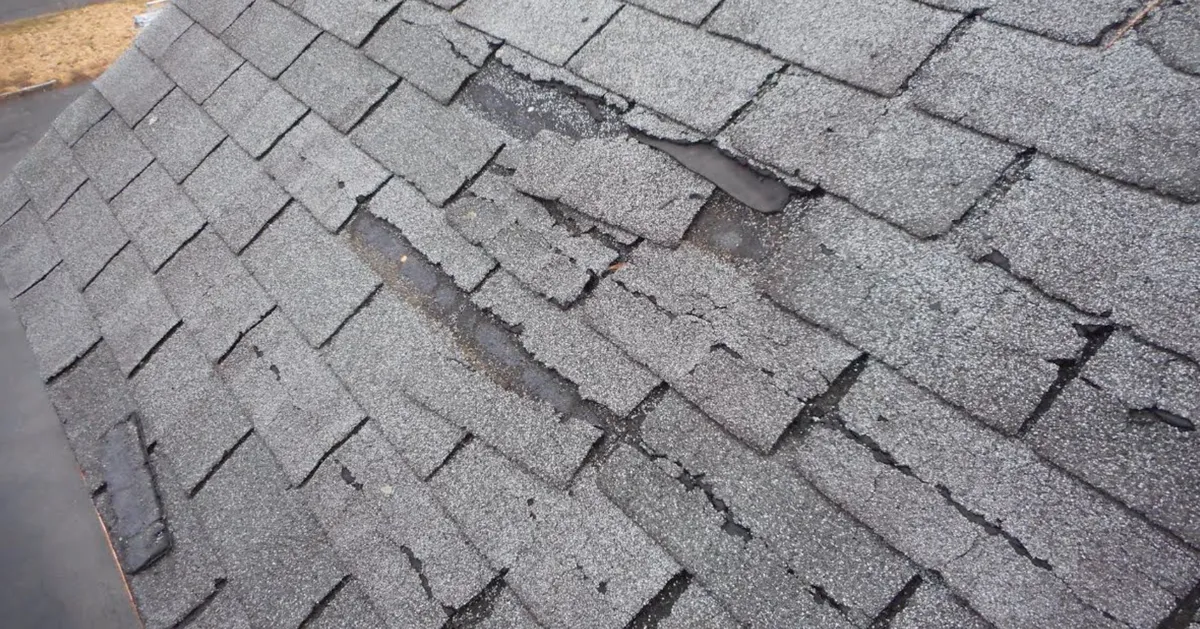
Photo: Sandul1234, CC BY-SA 4.0, cropped
Series: Field Notes
A buyer under contract on a house about ten years old asked about it on r/HomeInspections after the inspection found missing asphalt shingles. A relative who inspects had warned that shingles can't be fixed one at a time. The gap alone does not decide repair or replace; the roof around it does.
The post's first photo shows the inspector's report, which rated the roof covering poor: damaged and missing shingles on the south slope, exposed nail heads at a roof vent's flashing that should be sealed, and signs of impact damage and possible earlier ice damming in a valley. It recommended a roofing contractor. In the report's two roof photos, the problem shingles sit in short runs next to the vents near the ridge.
A patched repair that looks right versus one that doesn't
Photo: see the original post on r/HomeInspections.
Commenters read the photos differently. One saw damage from people walking on hot shingles, two unsealed fasteners and a few shingles to replace in two areas near the ridge. That commenter also said a good roofer can replace a single shingle. Another said the shingles looked good and only the damaged ones needed repair. A third said to replace the roof because water had already got in. The buyer added that the kickout flashing was not installed properly. Two of the commenters said the call needs someone on the roof.
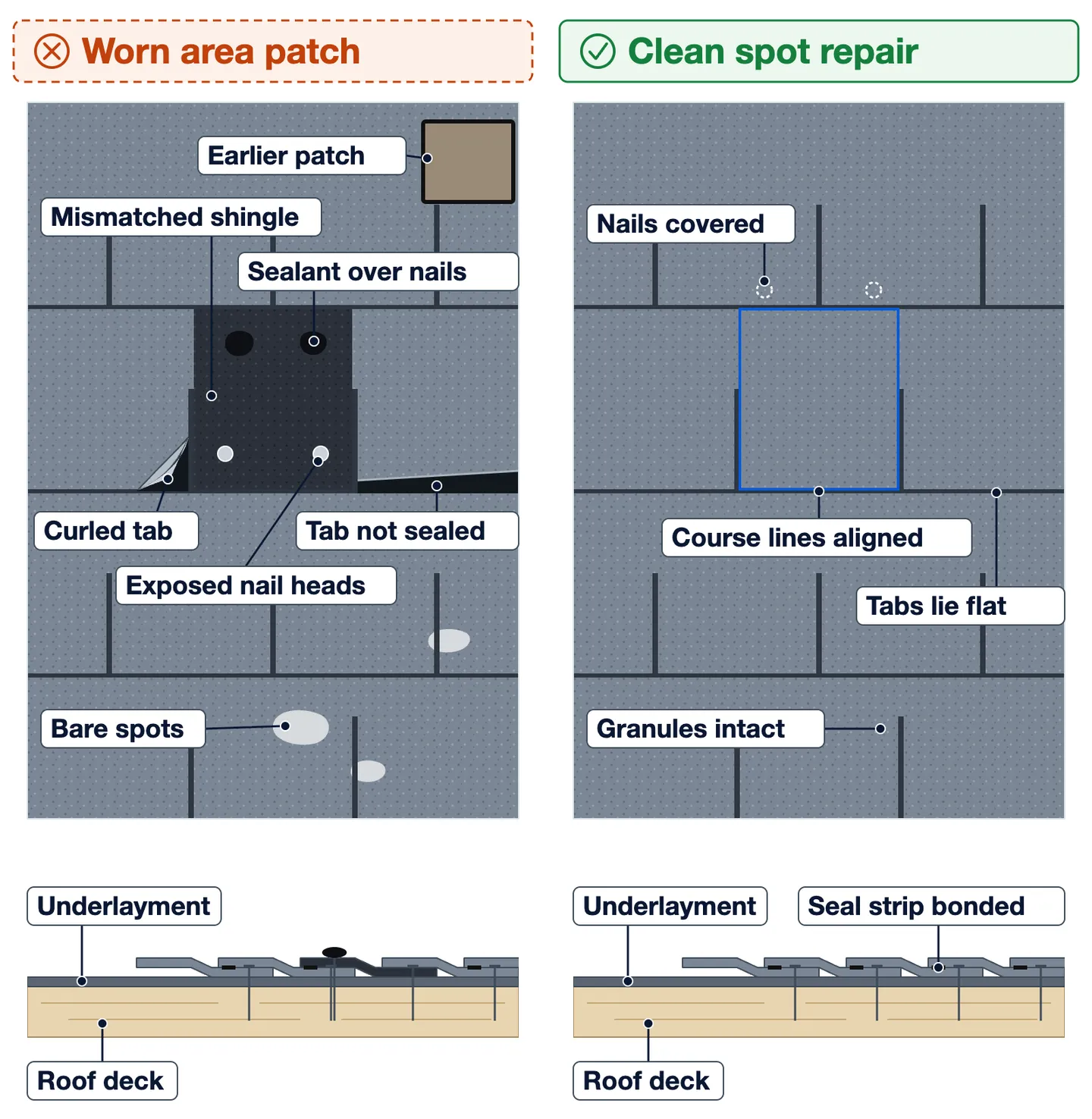
A spot repair is only as sound as the shingles it ties into. If the replacement lies flat, lines up with its course and the neighbors still seal down, the gap reads as a local event. Among lifted tabs, exposed fasteners and old sealant daubs, it is one symptom of a wider problem.
What to check when shingles are missing
- Where the loss sits: one slope or edge, or scattered across the roof.
- The shingles next to the gap: granule cover, flat sealed tabs, or curling, cracking and lifting edges.
- Fasteners: nail heads on the exposed face, nails backing out, or sealant smeared over them.
- Earlier repairs, such as mismatched shingles or several patches in one area.
- The attic deck under the area, if accessible, for staining.
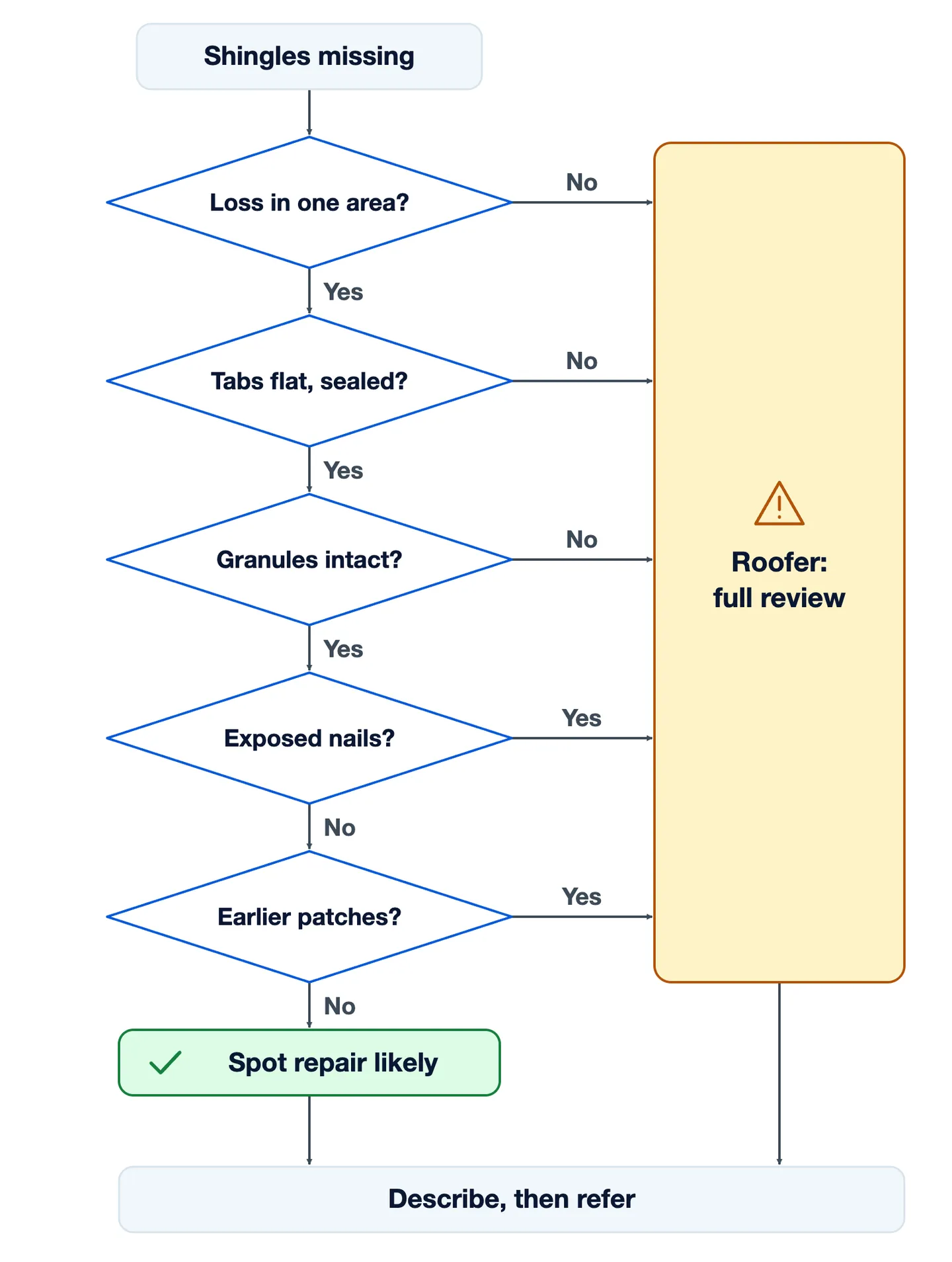
Missing shingles do not prove poor installation by themselves. That call needs the nailing checked directly, and lifting sealed tabs to look is usually the roofer's job.
What can change the callMore detail
Loss limited to one area, with sound and well-sealed shingles around it, leans toward a spot repair.
Shingles that crack when a roofer lifts them to slip in a replacement can turn a small repair into a larger job. That is one reason the roofer makes the repair-or-replace decision after handling the material.
A replacement shingle in a different color is cosmetic on its own. Note it if the buyer is likely to care.
Staining on the attic deck under the area changes the finding. It is no longer only about the roof covering, and the comment should say so.
Why this goes in the report
An open spot leaves the underlayment as the only layer between the weather and the deck. The buyer can act on that before closing, so it belongs in the report.
One clustered loss on sound shingles reads as a repair item. Scattered loss, brittle or bare shingles, or stacked patches make it a referral: a licensed roofing contractor evaluates the whole roof covering and says whether it can take spot repairs. Roof age is context. The surface cannot confirm a remaining-life number, so leave it out.
Photos to takeMore detail
- A wide shot of each slope, so the reader can see where the loss sits on the roof.
- A close-up of the gap with the underlayment or deck visible.
- The shingles next to the gap: tab edges, seal line and granule surface.
- Any exposed or backed-out fasteners and any sealant over nails.
- Each earlier patch, with enough of the slope to show how many there are.
- The attic deck under the area, if accessible.
Limits of this callMore detail
This is general guidance for writing up a finding. It is not roofing or engineering advice for a specific property, and it gives no cost and no remaining-life estimate.
Check your own SOP for what your scope requires on roof coverings and on walking the roof. Defer to a licensed roofing contractor on repair method and on whether the roof should be replaced.
How this goes in Morph
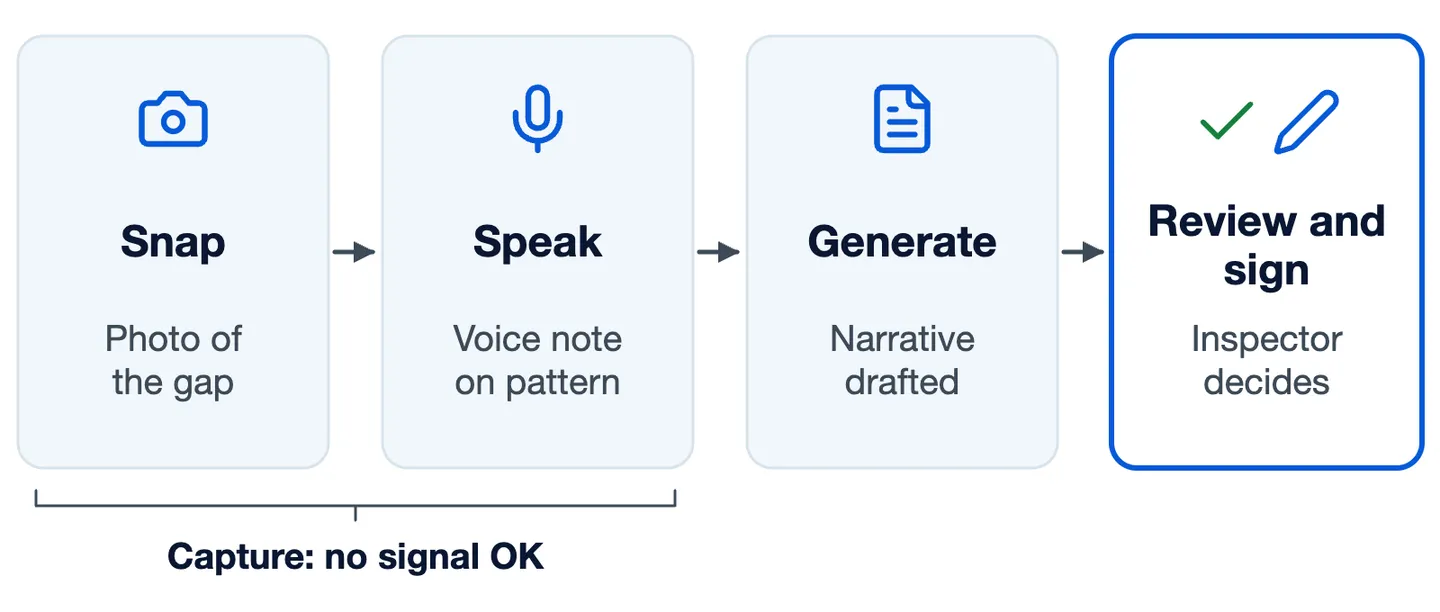
In Morph, this finding takes three steps: Snap a photo of the gap, Speak a voice note on the pattern, and Generate, where Morph writes the narrative on the spot in your own style. Capture works with no signal, and AI drafting runs when you're back online. Morph drafts and organizes, you review and decide, and nothing is sent without your approval. Your photos, voice notes, comments and wording are used only to write your own reports; Morph never uses them to train its AI and never shares them with or uses them for anyone else. Try the free plan on your next roof finding, and if it is not a good fit, that is fine too.
More videos and reading
- REPAIR ROOF SHINGLES - Replace Missing Aspahlt Roofing Shingles Step by Step Guide (ROOF REPAIR): a step-by-step video on replacing missing asphalt shingles.
- Your roof is leaking. Here is what you need to do RIGHT now. (Fortified Roofing): a video on first steps when a roof leaks.
- How to Fix Roof Leak in Asphalt Shingles (Practical Roofing Concepts): a video on repairing a leak in an asphalt shingle roof.
- NRCA Offers Repair Manual for Asphalt Shingle Roof Systems (NRCA): news of NRCA's repair manual for asphalt shingle roofs.
- Missing Shingles On Your Roof? Here's What To Do (GAF): a manufacturer article on what to do about missing shingles.
- Should You Repair or Replace Your Roof? (GAF): a manufacturer article on the repair-or-replace decision.
- How to Replace Missing Shingles (IKO): a manufacturer article on replacing missing shingles.
- Mastering Roof Inspections: Asphalt Composition Shingles, Part 55 (InterNACHI): part 55 of a roof-inspection series on asphalt composition shingles.
- Mastering Roof Inspections: Asphalt Composition Shingles, Part 11 (InterNACHI): part 11 of the same series.
- Asphalt Shingle Roof Covering Inspection Checklist (InterNACHI): an inspection checklist for asphalt shingle roof coverings.
- Inspecting Asphalt Shingle Roofs Course (InterNACHI): an online course on inspecting asphalt shingle roofs.
- Use of the Repairability Assessment Method for Evaluating Asphalt-Composition Shingle Roof Repairs (NAFE journal): a forensic-engineering paper on assessing whether shingle roofs can be repaired.
- Field Check for Shingle Flexibility and Brittleness (Itel): a field check for shingle flexibility and brittleness.
- A new resource for consumers (Professional Roofing): an article about a new resource for consumers.
- Roof repair expertise (Professional Roofing): an article on roof repair expertise.

Ready to streamline your inspections?
Morph uses AI to help inspectors work faster and deliver better reports.