Cast iron drain corrosion: when do you refer it out?
Internal corrosion in an old cast iron drain, with flaking and debris blocking the line: what it means, how to report it, and when to refer to a plumber.

Series: Field Notes
- 01Subpanel grounding: do you call out a missing ground?
- 02Cast iron drain corrosion: when do you refer it out?
- 03Missing roof shingles: repair or replace?
- 04Crimped flex duct on the roof deck: do you call it out?
- 05Bowed stud in a bearing wall: warped or structural?
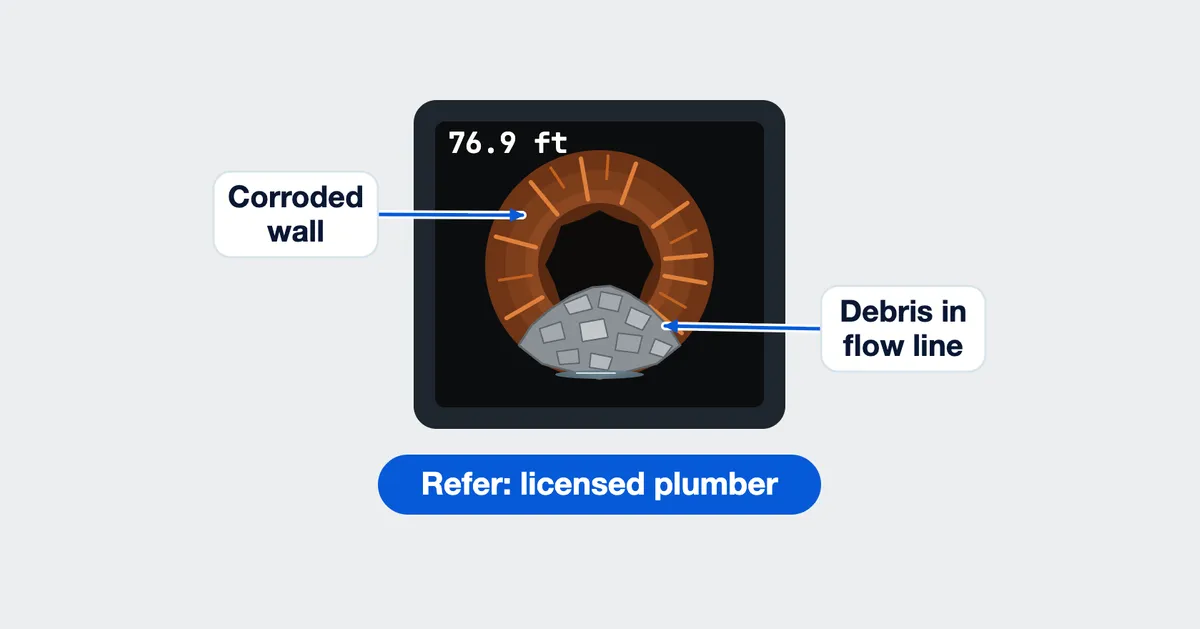
A first-time buyer under contract on a 1964 Florida house asked on r/HomeInspections whether flaking in the original cast iron drain under the slab was normal. The inspector had already marked it for immediate repair, and commenters agreed it was more than wear.
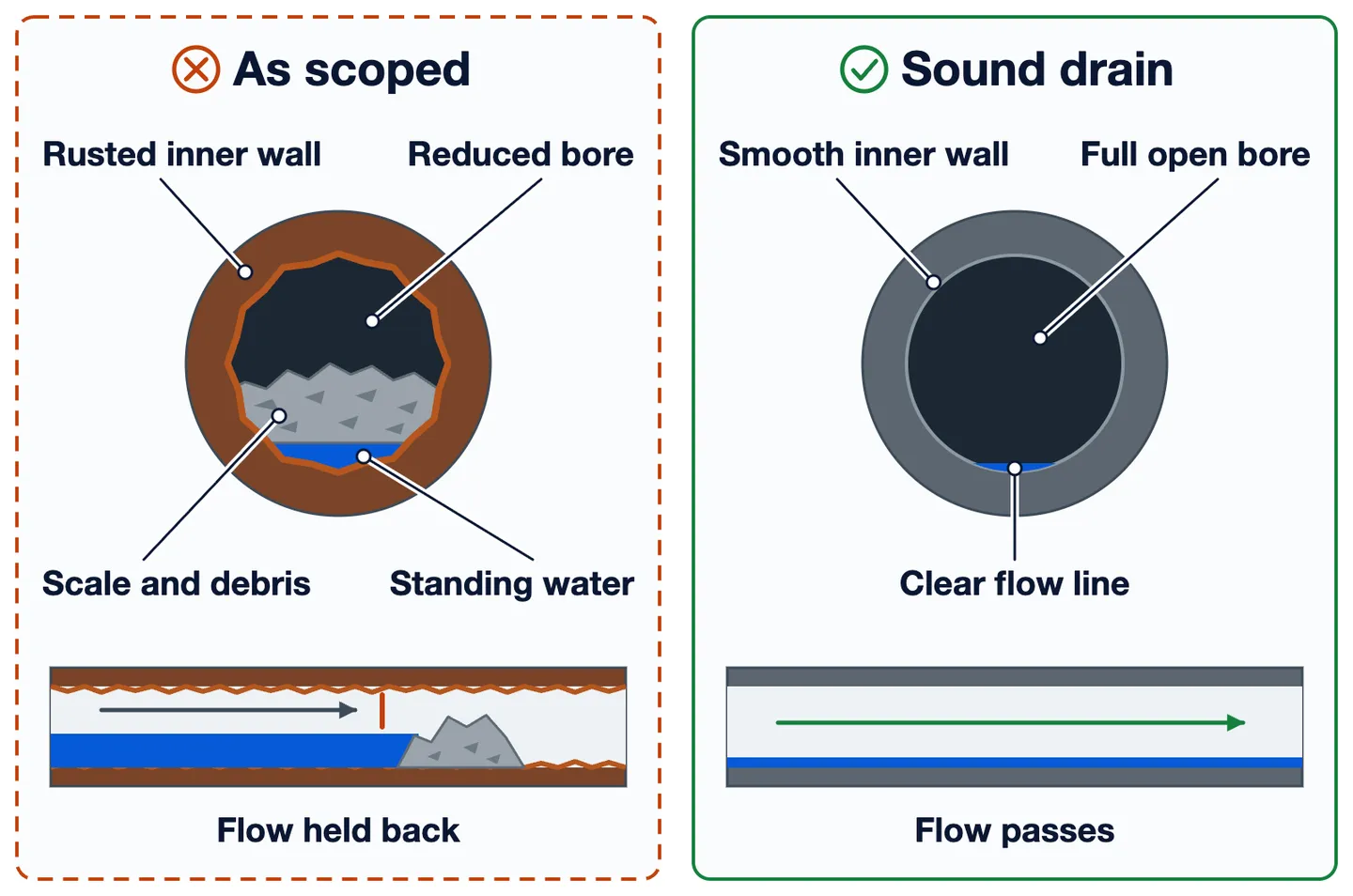
Wrong vs. right inside the drain
Photo: see the original post on r/HomeInspections.
The camera still in the original post is logged at 76.9 ft. Rust covers the wall all the way around. Loose scale sits on the bottom over standing water and blocks much of the lower half. A sound drain has a smooth bore and a clear flow line.
What to check on site when a cast iron drain is scoped
- The footage counter and the cleanout used for every still, so the plumber can find each spot.
- Corrosion on the wall, flaking scale, how much of the bore that the debris blocks, and standing water.
- Where the camera stopped, and what it met.
- Slow fixtures. In the thread, slow drainage is what prompted the scope.
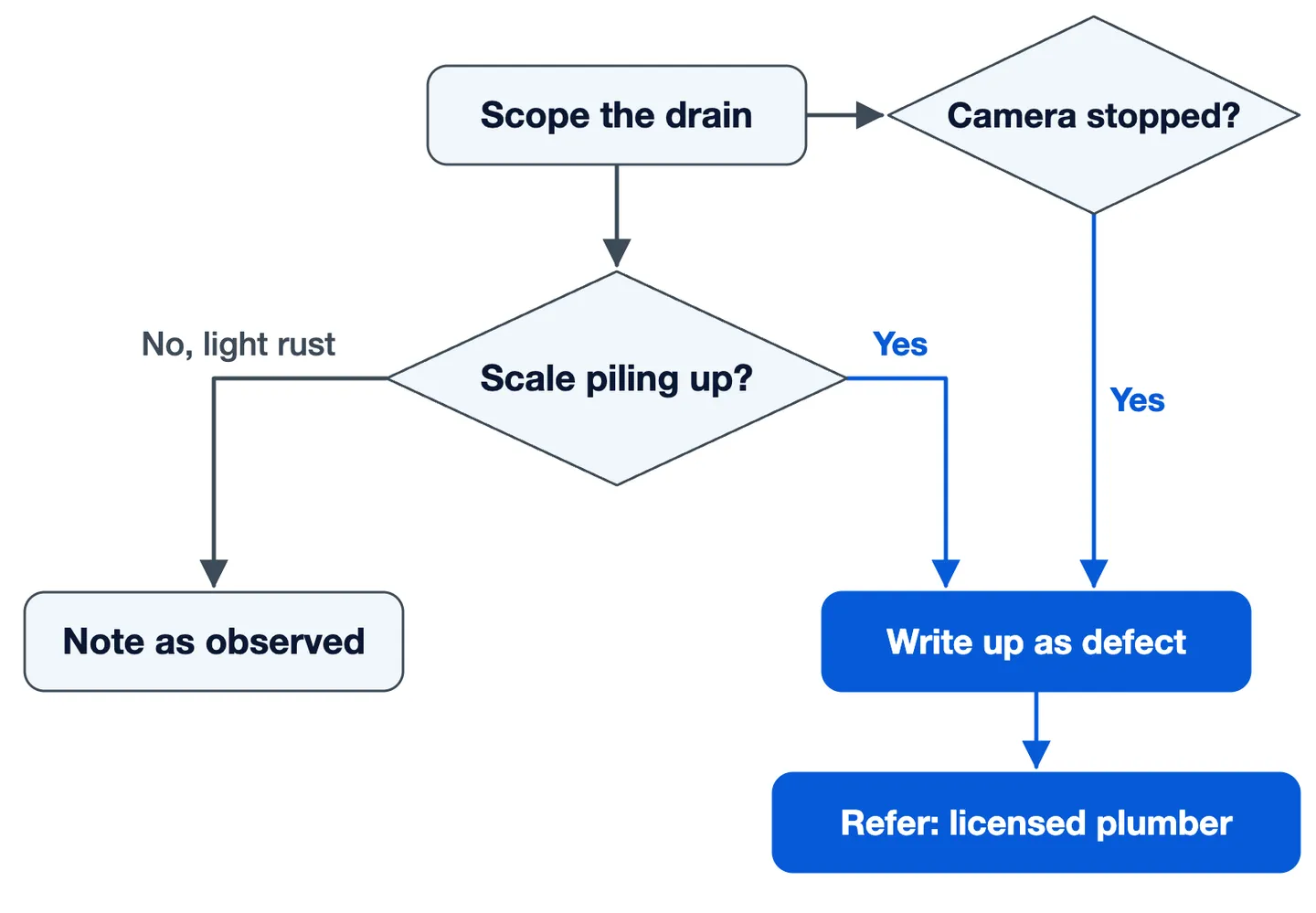
Why this goes in the report as a referral, not a diagnosis
The camera shows the pipe only where it reached. It cannot show wall thickness, hidden holes or how long the bad section runs. Those decide between lining and replacement.
Commenters leaned toward replacement. One said this pipe is past lining and needs new PVC. Another said nobody can tell whether it fails in weeks or holds for years. Those are calls for the plumber who scopes the full line.
When a damaged lateral changes who you refer to
The buyer described a second problem in text only. Toward the street, the camera hit wet dirt about 8 feet from the front cleanout and could not go on. Write that as where the camera stopped and what it met. One commenter added that the cost can go up if work is needed in the road where the line meets the main, so the referral should cover the lateral all the way to the city connection.
The frog, and other things known only from the threadMore detail
The buyer mentioned a frog in another gallery photo that isn't included here. A commenter said that a frog in the line means the pipe is open to the outside, which it should not be. Treat that as the commenters' observation, not something the available camera still shows. The disconnected lateral is also known only from the buyer's text, where the inspector's finding is quoted as a damaged lateral that appeared to be disconnected. One commenter added that underground cast iron should be replaced at some point, while working cast iron inside the house can be repaired piece by piece.
Photos to take for the write-upMore detail
Take a still at each change in condition, with the footage counter visible. Take one at the point where the camera stopped. Note the cleanout used and the direction (toward the house or toward the street). Record slow fixtures with a short note of which ones.
Limits of this callMore detail
This post covers how to describe and refer the condition. It is not engineering or plumbing advice for a specific property, and it gives no service-life figure or repair cost. Whether a sewer scope is inside your scope of work depends on your standards of practice and your agreement.
How this goes in Morph
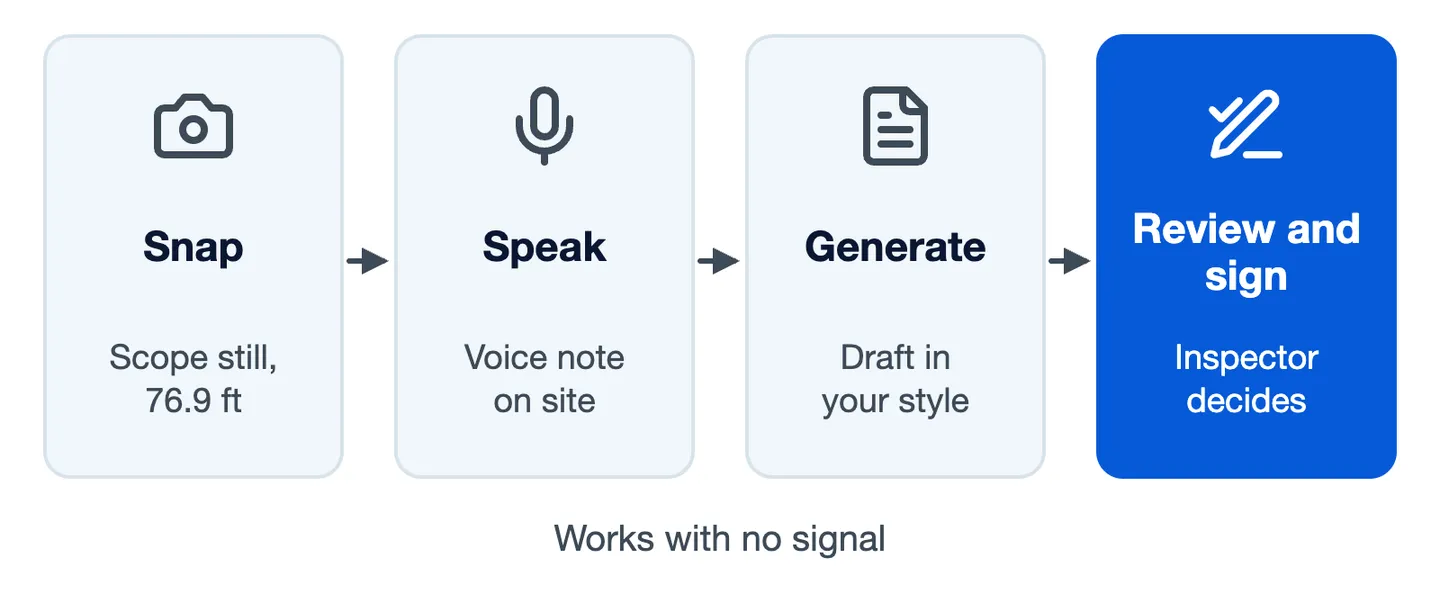
Snap the scope still with the counter showing, then speak what the camera met. Morph turns the photos and voice notes into a narrative in the inspector's own style, built from their templates and past writing. Capture works with no signal. Morph drafts, the inspector reviews and decides, and nothing is sent without approval. The inspector's templates, comments, voice notes and wording are used only for their own reports, never to train Morph's AI and never for anyone else. If it is not a good fit, that is fine too.
More videos and reading
- How to Repair Cast Iron Pipe Cracks, Avoid Plumbing Fails (jeffostroff): repairing cracks in cast iron pipe.
- Dirty Cast iron Pipe Sewer Drain Camera Inspection (CORAL ROCK PLUMBING INC.): a camera inspection of a dirty cast iron sewer drain.
- Sewer scope Cast Iron and Orangeburg Piping (Blackstone Property Inspections): a sewer scope of cast iron and Orangeburg piping.
- Cast Iron Pipe Corrosion & Drain Issues (Home Inspector Dan | Phoenix, Arizona): cast iron corrosion and drain problems.
- Super Gross Cast Iron Sewer Pipe Replacement (Mechanical Hub): replacing a cast iron sewer pipe.
- Epoxy Pipe Coating on Cast Iron (Roots Plumbing - Cape Winlands): epoxy coating inside cast iron pipe.
- Trenchless Pipe Lining: Restoring Pipes With Epoxy CIPP (HK Solutions Group): trenchless epoxy lining (CIPP).
- How to easy cut & removal of Cast Iron Pipe - cutting with special cutter (TileMasterGa): cutting and removing cast iron pipe.
- Tuberculation Removal (American Pipeline Solutions): removing corrosion buildup from pipe interiors.
- Cast Iron Drain Pipes (InterNACHI Forum): an inspector discussion of cast iron drain pipes.
- I'm new to sewer scoping and need a little help with this one (InterNACHI Forum): a newer inspector asking for help reading a sewer scope.
- Home Inspections in Oceanside, Ca - Damaged Cast Iron Plumbing (InterNACHI Forum): a thread on damaged cast iron plumbing.
Ready to streamline your inspections?
Morph uses AI to help inspectors work faster and deliver better reports.